← Back to blog Article
Ruby and Spinel — a buyer's field guide
How two of Myanmar's most famous gem species can look alike at a glance, and how to look at them correctly when you are buying.
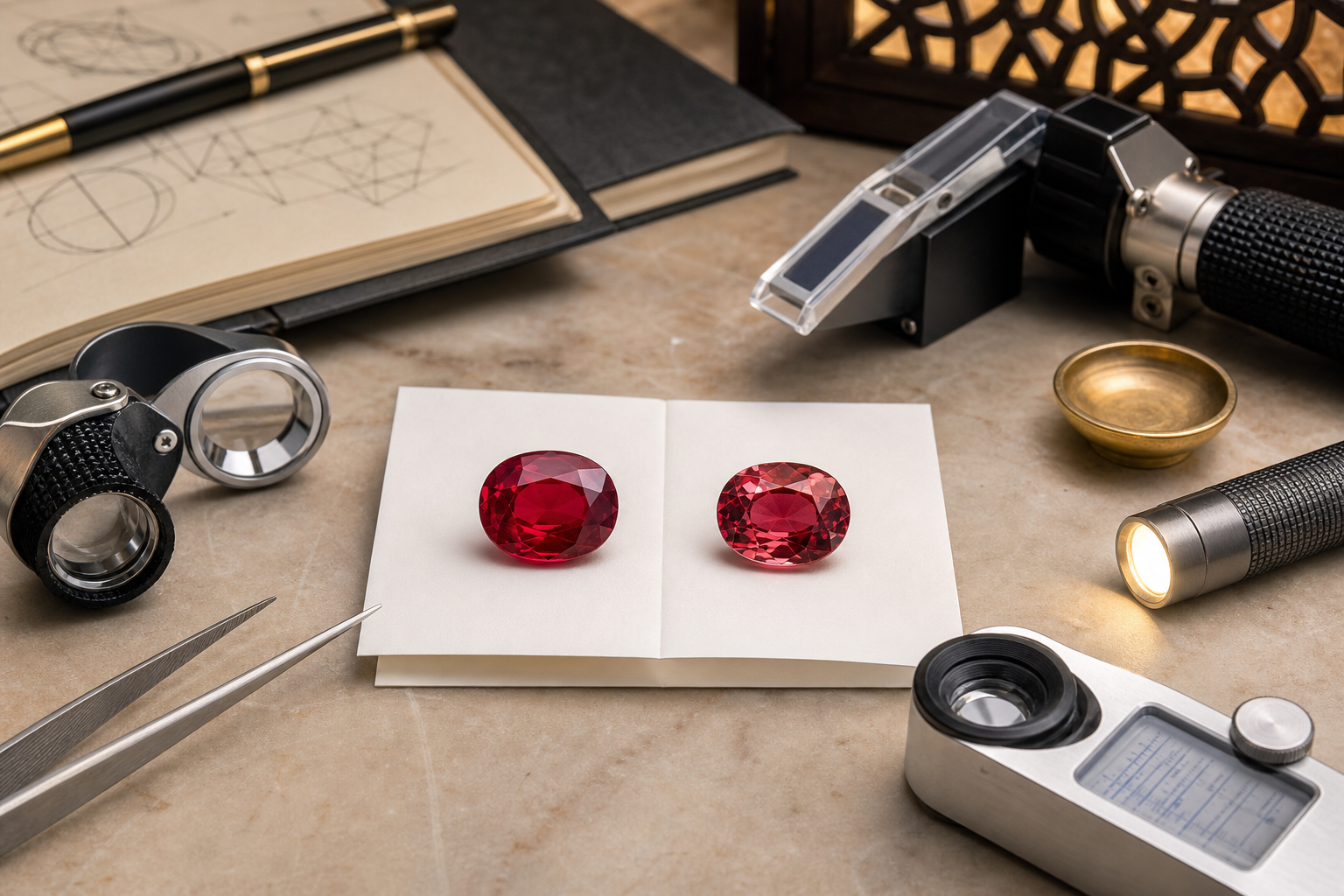
Ruby and red spinel can look identical to the untrained eye. For centuries, the two stones were sold interchangeably under the name “Balas ruby” — and Burma’s most famous historical “ruby” the Black Prince’s Crown Jewel is now known to be a spinel.
Quick visual cues
- Ruby tends to show a slight milky or “silk” character under strong magnification, especially in stones from Mogok.
- Spinel typically shows a cleaner internal appearance and octahedral crystal inclusions.
These cues are not diagnostic on their own — every stone should be confirmed by an independent laboratory — but they are useful when deciding whether a stone is worth the cost of a lab report.
What a lab will test
YGIL uses standard gem instruments to distinguish the two:
- Refractive index — a quick separation: ruby is approximately 1.762, spinel approximately 1.712.
- Spectroscope — chromium lines in both, but red spinel shows a distinctive pattern that differs from ruby.
- Microscope — silk in ruby, crystal inclusions in both, occasional characteristic fingerprints in spinel.
If you would like the lab to confirm a stone before you commit, see our lab services.